

26th Textile Industry Forum
STRATEGY FOR AN EFFECTIVE PARTNERSHIP BETWEEN BRANDS AND INDUSTRY
On November 26, 2024, Casa das Artes, in Vila Nova de Famalicão, hosted the 26th Textile Industry Forum, an emblematic event that brought together businesspeople, experts and political decision-makers to debate the central theme: “Strategy for an Effective Partnership between Brands and Industry“. This forum stood out in its approach to the main trends, challenges and opportunities in the textile and clothing (ITV) sector, crucial for the Portuguese economy.
Sector Opening and Priorities
The session was opened by the councilor of the Famalicão City Council, Augusto Lima, who reinforced the relevance of innovation, entrepreneurship and talent for the sustainability of the sector.
Then, the president of ATP, Mário Jorge Machado, presented an analysis of the state of the sector, highlighting the resilience and innovation of Portuguese ITV, but pointing out critical areas that require attention:
- Competitive energy: Reduce costs and ensure accessibility.
- Simplified bureaucracy: Making processes more efficient to support companies.
- Incentives for production and internationalization: Boosting global competitiveness.
- Favorable taxation: Create fairer and more attractive conditions for business growth.
- Sustainability in public procurement: Promotion of ecological and added value criteria.
These areas constitute the foundation for the modernization and strengthening of ITV in globalized and demanding market contexts.
Recognition and Ecological Transition
The Secretary of State for Economy, João Rui Ferreira, highlighted the importance of the textile sector in the context of ecological transition and technological innovation. He recognized that the Portuguese textile industry not only responds to these challenges, but also leads transformations that shape the future of the sustainable economy.
Industry Trends and Data
Hermano Rodrigues, director of EY-Parthenon, presented ITV’s main economic indicators, emphasizing three structuring factors: quality, tradition and innovation. Despite consistent growth in recent years, the most recent data from 2023 and 2024 indicated warnings regarding international competitiveness, reinforcing the need for strategic measures to keep the sector dynamic and relevant.
Fashion Macrotrends and Opportunities
Daniel Agis, specialist in brand building, addressed the changes expected in the fashion industry over the next five years. Among the highlights:
- Artificial Intelligence (AI): Automated strategic decisions and changes in production processes.
- Mixed realities: Connection between the physical and the digital in the creation and consumption of fashion.
- Sustainability and innovation: Focus on the circular economy, reducing waste and improving the relationship between brands and consumers.
Christian Schindler, general director of ITMF, projected the sector’s growth in new markets and highlighted the importance of diversification, while Dirk Vantyghem, from EURATEX, warned of the impact of new European regulations, a central issue for companies operating in the global market.
Debate: Building Effective Partnerships
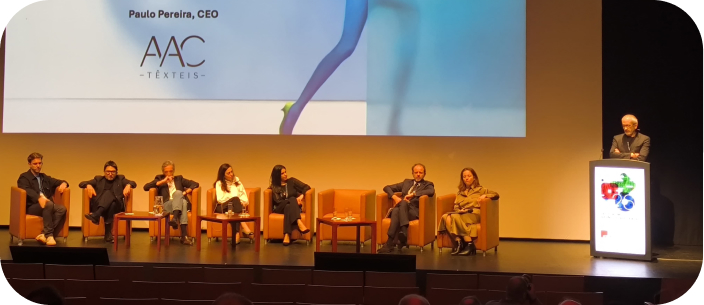
In the panel moderated by Ana Paula Dinis, general director of ATP, the need for close collaboration between brands and industry was discussed, with the participation of representatives from both brands and production.
Identified Strengths
- Productivity: High production capacity with efficiency.
- Sustainability: Processes oriented towards ecological practices.
- Innovation: Constant technological adaptation.
- Integrated services: Complete and personalized offer to partners.
Challenges to Overcome
- Financing: Need for adequate resources for strategic projects.
- Communication and alignment: Improve synergy between customers and suppliers.
- Flexibility: Respond quickly to market changes.
Among the participants in the debate, names such as Blake Sturgess (Pangaia), Federico Bigliardi (D.Rt) Hélder Brito (Inimigo Clothing), Manuel Lopez Tocci (El Corte Inglés), Alberta Marimba (Somelos), Dionísia Portela (Confetil) and Paulo Pereira (AAC Têxteis) stood out, who shared practical perspectives on how to optimize relationships between brands and suppliers.
Conclusion and Perspectives
The 26th Textile Industry Forum was a unique opportunity to identify paths for effective cooperation, reinforcing Portuguese ITV as a strategic pillar in the national economy. The challenges posed by an increasingly regulated and competitive market can only be overcome with the combination of innovation, sustainability and appropriate public policies.
The event reaffirmed that, to prosper, the sector must embrace structural changes and invest in partnerships between brands and industry, building a more competitive, sustainable future and connected to new global demands.
Discover the solutions from NITextile and prepare your company for the future:
📨 geral@nitextile.pt
🌐 www.nitextile.pt