

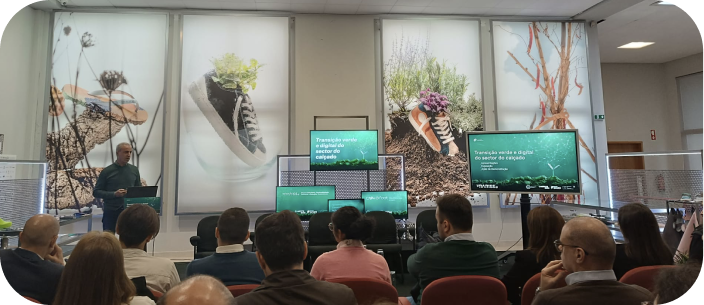
Green and Digital Transition of the Footwear Sector
NITextile participated in the Green and Digital Transition of the Footwear Sector event, organized by the Footwear Technological Center of Portugal (CTCP), which took place on November 15th, with a focus on combining sustainability with digital transformation reduces costs and environmental impact, making the Portuguese footwear industry more appealing to customers and competitive in the global market.
The event began with the presentation of the two projects RARISS and CNI4FOOT4.0, by Maria José Ferreira (CTCP), which focused on developing solutions to boost the transition, attesting to their practical, economic and environmental advantages.
In the RARISS Project Autochthonous Breeds, Traceability, Innovation and Sustainable Solutions were promoted by Joaquim Gaião, CTIC, Miguel Freitas and Francisca Magalhães, KYAIA and Patrícia Costa, CTCP. This project focused on three main areas:
- Bovine Skins: the focus of this development was on sustainable cattle breeding for the food sector, where the skin will be a by-product for the footwear industry. The quality of the skins improves with the quality of animal treatment, in this sense a guide of good practices for animal treatment was created and a commitment to periodic audits with animal producers was created in order to guarantee the application of good practices.
- Traceability of bovine hides from indigenous breeds: a traceability and animal welfare label was created that accompanies the entire process from the creation of the animal to the treatment of the hides in order to guarantee their traceability, in addition a platform was created (https://traceleather.ctcp.pt/) that allows the value chain and the consumer to have access to information about the value chain, in order to value information transparency, responsible supply, process traceability and eco-efficiency of hides. This digital tool that allows the client or consumer to trace the origin of leather, contributing to transparency in the supply chain and the use of socially, ethically and ecologically appropriate materials.
- A sustainable production process was demonstrated by the development of a KYAIA product, which focused on the entire previous process and the development of a more simplified and sustainable product, where environmental impact assessments were carried out. Furthermore, the new product has a QRcode with information relevant to the end consumer, about the value chain and aspects of the product’s impact.
In the CNI4FOOT4.0 Project: Sustainable Smart Supply Chain in the Footwear Cluster – Digitalization of the Value Chain, led by Rui Rebelo from INESCTEC, Paulo Leal, CORTGIN and Patrícia Costa, CTCP: This project was focused on the development of digital tools for the “Shop Floor” combining technologies, namely:
1) Tools to support operating ranges in order to eliminate paper and increase the quality of the information provided.
2) Real-time production process control with RFID technologies, where it is possible to obtain productivity information, but also create product verification systems to avoid human errors. This implementation focused on not creating new tasks, that is, taking advantage of existing tasks and adapting the system to the manufacturing line
3) Classification of suppliers using machine learning technology, with assessments of compliance with delivery deadlines, historical analysis with calculation of delivery probability.
4) Reception of materials with automatic allocation. All digital tools developed were validated in an industrial environment and demonstrated a reduction in operating times, support
5) Production planning with production capacity models per section, information on levels of capacity restrictions and availability of materials, calculation of the probability of executing the plan, with risk assessment of meeting delivery dates and automatism for maximizing compliance with delivery deadlines.
6) Web platform for communicating with suppliers, sending requests with active records and alerts, confirming delivery times, sharing secure information and labeling.
7) Use of fast and economical digital technologies to monitor and optimize the supply chain, footwear production and shipping, reducing time, errors, waste of resources and environmental impacts.
Both projects show the alliance between digital transformation and sustainable development, they can bring product or process innovation combined with productive efficiency and product quality.